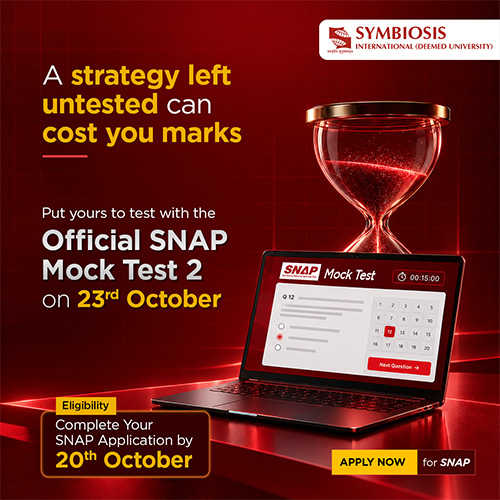
SNAP preparation 2026 starts with learning the four-section pattern and key topics, then practicing high-frequency topics and analysing timed mocks every week. SNAP is easier than CAT or XAT. However, considering the limited number of seats in the affiliated colleges, the exam becomes quite competitive and challenging.
This SNAP Preparation guide covers the exam structure, section-wise strategy, a three-month plan, mocks, books and FAQs.
SNAP 2026 at a Glance
Symbiosis International (Deemed University), Pune, conducts SNAP for 29 MBA programmes across 17 institutes, including SIBM and SCMHRD.
- Registration: 21 August 2026 to 25 November 2026
- Exam dates: 13, 19, and 26 December 2026 (up to three attempts; best score counts)
- Cities: 79
- Result: 12 January 2027
- Competition: about 1.45 lakh to 1.5 lakh candidates appear each year.
Apply on snaptest.org. Test registration and program fees are separate. To help you crack SNAP with a high score, our experts have developed a smart strategy for each section.
What are the SNAP 2026 important dates?
SNAP 2026 registration is underway from August 21, 2026, to November 25, 2026. The three test dates are scheduled for December 13, 19, and 26 December 2026.
|
Event
|
Dates
|
|
SNAP 2026 Registration opens
|
August 21, 2026
|
|
SNAP 2026 Registration and Payment Closes
|
November 25, 2026 (Wednesday)
|
|
Admit Card Availability
|
- SNAP 01: December 07, 2026 (Monday)
- SNAP 02: December 11, 2026 (Friday)
- SNAP 03: December 18, 2026 (Friday)
|
|
SNAP Test (Multiple Attempts)
|
- SNAP 01: December 13, 2026 (Sunday)
- SNAP 02: December 19, 2026 (Saturday)
- SNAP 03: December 26, 2026 (Saturday)
|
|
Announcement of Result
|
January 12, 2027 (Tuesday)
|
What to know before SNAP preparation?
Candidates must know the pattern, marking scheme, and syllabus first, because SNAP has no sectional time limit and no sectional cut-off in the written test. You can switch sections freely, so question selection is part of SNAP preparation, not an afterthought. Institutes still shortlist based on overall SNAP percentile.
What is the SNAP 2026 exam pattern?
SNAP 2026 has 60 questions and 60 marks in 60 minutes across four sections. The following table shows the
exam pattern of SNAP:
|
Section
|
No. of Questions
|
Total Marks
|
|
General English: Reading Comprehension, Verbal Reasoning, Verbal Ability
|
10
|
10
|
|
Analytical & Logical Reasoning
|
20
|
20
|
|
Quantitative, Data Interpretation & Data Sufficiency
|
20
|
20
|
|
Ethics, Morality and Values
|
10
|
10
|
|
Total
|
60
|
60
|
What are the important features of SNAP?
SNAP is a 60-minute computer-based test with 60 questions, each worth 1 mark, and allows up to 3 attempts. The best of the three scores will be used for admission.
- Mode: Computer-Based Test (CBT)
- Duration: 60 minutes
- Sectional time limit: None
- Correct answer: +1
- Wrong answer: −0.25
- Unattempted: 0
- Attempts: up to 3; the highest score is used; no normalization
English has 10 questions (not 15). Analytical & Logical Reasoning is 20 (not 25). Ethics, Morality and Values is new in SNAP 2026. The section-wise question distribution changed due to the addition of the Ethics, Morality and Values section, but the total number of questions has remained the same.
What is the syllabus for SNAP preparation?
SIU does not offer a detailed official list of topics. Use past papers for the first 3 sections. SNAP has recently added an Ethics, Morality, and Values section, but its topics are not currently available for preparation. The important topics for each section that will assist you in SNAP preparation are listed below:
Quant, DI, & DS: This section has questions from arithmetic, algebra, geometry, data interpretation and related topics. Questions on mathematical concepts usually dominate more than the one on DI and DS.
General English: Most questions test grammar and vocabulary through fill-in-the-blanks, one-word substitution, analogies, synonyms and antonyms. A few short reading comprehension items may appear. Syllogisms are more common in the Reasoning section.
Analytical & Logical Reasoning: This part includes questions on common reasoning concepts like Coding-decoding, puzzles, blood relations, arrangements, series, calendars, and clocks.
Ethics, Morality and Values: This newly introduced section is expected to assess candidates' ethical judgment, moral reasoning, values and decision-making abilities. Important areas include ethical principles, honesty and integrity, fairness and impartiality, accountability, conflicts of interest, social responsibility, workplace ethics and situation-based decision-making.
How to prepare for SNAP 2026?
SNAP preparation has three layers: learn the official pattern and finish high-frequency topics in all four sections, then take one timed mock a week and review it the same day. Aim for about 40–45 accurate attempts, not all 60. After every test, separate concept errors, calculation errors and poor question selection.
Use all three SNAP dates: treat Test 1 as a live benchmark if needed, then correct only repeated mistakes before Tests 2 and 3.
Develop a Study Schedule: The first step to staying focused and preparing as well as possible is to create a study plan and stick to it. Ideally, you should set a timeline to complete the conceptual learning of key topics and practice accordingly.
Evaluate Yourself: To be an expert in any field, practice is the key. So, you must attempt topic-wise tests, sectional tests, and full-length mock tests. Also, review previous years' papers to get a clear idea of the pattern and expected questions.
Analyse your Performance: After every test you take, review your performance and identify your strengths and weaknesses. This analysis will help you build a better exam strategy and score higher.
What Is the Section-Wise Strategy for SNAP Preparation 2026?
SNAP Preparation can be split into three parts: concept-driven, practice-intensive, and environment-sensitive. Quantitative Ability & select areas of General English are concept-driven; Data Interpretation & Logical Reasoning are practice-intensive. Ethics, Morality and Values are judgment-driven & environment-sensitive.
How to prepare for Quant, DI and DS?
SNAP 2026 assigns this section 20 questions/20 marks in a 60-minute paper with +1/−0.25 and no sectional timer. Arithmetic is usually dominant; DI and DS appear in smaller numbers than in CAT. Aim for 14-16 accurate attempts rather than all 20.
- Revise the Class 9-10 NCERT school Math books and practice questions from R. S. Aggarwal’s Quantitative Aptitude book.
- Since fast calculations can save time, practice with tables, squares, cubes and decimal-fraction conversions. This will develop your comfort level with numbers.
- You should regularly attempt mock tests to identify your strong and weak areas.
How to prepare for General English?
In SNAP 2026, this section has 10 questions/10 marks. Most items are fill-ups, error spotting, one-word substitution, synonyms/antonyms, analogies and short verbal usage. Reading comprehension, if it appears, is short and infrequent. Spend 8–10 minutes here and aim for 8–9 accurate attempts.
- Revise agreement, tenses, articles, prepositions and parallelism.
- Learn 15–20 words a day and revise yesterday’s list.
- Practice fill-ups, error spotting, one-word substitution and analogies.
- Read editorials for usage, not long CAT-style RC.
- Attempt vocab first, grammar next.
- Core books: Wren & Martin; Norman Lewis Word Power Made Easy.
How to prepare for Analytical & Logical Reasoning?
In SNAP 2026, this section has 20 questions / 20 marks (down from 25 in 2025). There is no sectional timer. Spend 20–22 minutes and aim for 15–17 accurate attempts. Reasoning is practice-intensive, not theory-heavy.
- You can practise Logical Reasoning using puzzle books and other reasoning books.
- You can also benefit from R. S. Aggarwal's book on reasoning, which is easy to find.
- Practice across similar questions from previous year SNAP papers and mock tests.
How to prepare for Ethics, Morality and Values?
SNAP preparation for Ethics, Morality and Values should focus on judgment, not theory.
This section of SNAP 2026 contains 10 questions for 10 marks. SNAP preparation here means practicing short workplace cases on integrity, fairness, accountability, conflict of interest, CSR, and situation-based decisions, as there is no detailed official syllabus released by SIU.
- Know the basic ethical principles: Honesty, integrity, fairness, responsibility and accountability.
- Apply ethical dilemmas and decision-making to the situational questions.
- Think about the impact of a decision on different stakeholders, e.g. individuals, organisations, and society.
- Avoid personal bias and evaluate situations objectively based on fairness and impartiality.
- Analyse the short-term and long-term consequences of different courses of action.
- Practise identifying the most appropriate ethical response when multiple options appear reasonable.
- This section is newly added, so you can review the official updates and sample questions issued by SNAP authorities.
What is a 3-month SNAP preparation plan?
Use month 1 for concepts, month 2 for timed practice and month 3 for mocks. This plan assumes a September start before SNAP 01 on December 13, 2026.
What should I do in month 1 of SNAP preparation?
Finish high-frequency concepts in all four sections.
- Quant: 20 questions a day, arithmetic first.
- English: grammar + 15–20 words a day.
- Reasoning: one type at a time; 3 sets a day.
- Ethics: principle notes + 5 short cases a week.
- Two topic tests a week; one mixed sectional by week 4.
What should I do in month 2 of SNAP preparation?
Move to section timings and one full mock every week.
- Daily timed mix: Quant 25 minutes, LR 22 minutes, English 10 minutes, Ethics 8–10 minutes.
- One 60-minute mock weekly with +1/−0.25.
- Analyse the same day (concept vs calculation vs selection).
- Add a 10-question Ethics block to old 3-section mocks.
What should I do in month 3 of SNAP preparation?
Simulate the exam and freeze strategy.
- Weeks 9–11: 2–3 full mocks a week; no new chapters.
- Week 12: one mock and light revision.
- Take SIU’s official mock after you register.
- Freeze section order (many students do English and Ethics first).
- SNAP 01 = benchmark; SNAP 02 and 03 = fix repeated errors only.
Two to two-and-a-half hours a day is enough if the mix is fixed: Quant + Ethics (Mon–Tue), LR + English (Wed–Thu), weak topics (Fri), mock (Sat), analysis (Sun).
SNAP preparation FAQs
Q. How should I use mocks in SNAP preparation?
A. Take 12–18 well-analysed 60-minute mocks rather than 40 unreviewed papers.
Review the same day: which section leaked time, which questions you should have skipped, which Ethics options you overthought. Keep an error log and revisit it twice a week. Official SIU mocks show the interface and the likely 2026 Ethics, Morality and Values question types.
Q. What are the best books for SNAP preparation?
A. Use NCERT and R.S. Aggarwal for Quant, Wren & Martin and Norman Lewis for English, R.S. Aggarwal plus SNAP PYQs for Reasoning, and short case sets plus the official mock for Ethics.
CAT books help with concepts. SNAP-specific 60-minute mocks transfer better to test day. Confirm any year-wise PYQ book you name on the live page.
Q. What should I do on SNAP exam day?
A. Start with easy questions, switch when a set stalls, and guess only after eliminating two options.
Unused questions score 0; wrong ones cost 0.25. If you have another attempt, write five issues immediately after the paper and drill only those before the next date.


 E-305, Industrial Area, Sahibzada Ajit Singh Nagar, Punjab 160055, IN