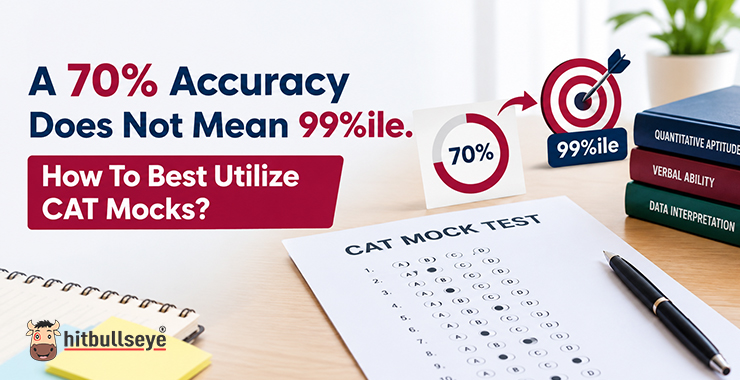
CAT 2026 is scheduled to be held on November 29, 2026, which falls on a Sunday. If we set October 8 as the date, every aspirant will have about seven weeks to strengthen their core. Devising a new study plan or starting to build proficiency on a new topic is out of the cards at this point. The exam will be set by IIM Indore and will continue to follow its old pattern of 68 questions and 204 marks, divided amongst three sections of 40 minutes each, as the sectional timing is still imposed. The sectional division allots VARC with 24 questions, and 22 questions each in DILR and QA. Shedding light quickly on the marking scheme, a correct answer awards every aspirant 3 marks, while an incorrect answer costs 1 mark. The IIMs do not officially publish a marks-to-percentile table or their cut-off ranks. The numbers depicted below are an estimate devised after careful observation of CAT 2024 and CAT 2025 trends. The following article has been curated with the aim of killing just one comforting idea: A low-accuracy paper, more attempts, eventually turns into a 99 on the day.

A 99 in CAT 2025, across slots and sources, corresponds to a scaled score somewhere between the low 80s and the mid-90s. The December estimate scaled score near 79 corresponded to the 99th percentile, while a score of about 88-89 corresponded to the 99.5th percentile. CAT 2024 needed still more for the same badge in some slots, around the mid-90s. Seventy marks, the score a careless mock feels proud of, were about a 95 in 2024 and about a 97 in 2025. It was never a 99. The gap between a strong attempt and a 99 percentile attempt has been anywhere from roughly 10 to 20 marks, depending on the year and the slot. It could be three or four accurate answers you did not know how to attempt, or maybe they were four wrong MCQ guesses that you made.
To demonstrate with a decent example, take a paper on which you attempt 40 questions at 70% accuracy. Now evaluate it, summing an accuracy of 26-28 correct attempts, with, let’s say, 12 incorrect ones. This means that the total score for this mock test is 28 × 3 − 12 = 72, concluding this score to be a respectable mock. To compare this score with the CAT competition value, the score would have stood at the mid-90s. In another example, if the 70% accuracy was replaced with 50, the CAT mock test score would leave the candidate with 35 correct answers and 15 incorrect ones, resulting in a score of 90. The same 35 correct answers with only 5 wrong answers would have been a score of 100. Now the difference is not talent, rather a calculated choice that leads to a major difference.
The negative marking is the real game here; each wrong answer forces the candidate to lose one mark that they had already scored in another answer. Additionally, the potential of gaining 3 marks from the question that wasn’t correct. At 70% accuracy, candidates spend a large share of the section winning marks, only to give them back to negative marking. At 85%, you give fewer back. At 90%, almost every attempt converts into a positive and rewarding score.
Further, sectional scores make the same point, but in small, often unnoticeable gaps. According to CAT 2025 estimates, a 99 percentile roughly meant 40 correct answers in VARC, the high 20s to high 30s in DILR, and the low 30s in QA, with wide slot variation.
Another reason you could typically utilize your last few mock test attempts wisely would be to learn that accuracy under time constraints helps you learn the skill that is essential to master CAT. Therefore, the last mocks are not there to raise your syllabus coverage. They are there to help you learn and understand an amalgamation of accuracy, speed, and time management skills.
How to Best Utilize Mock Tests?
The first job is important to learn how to build an attempt cap you can keep. Decide quickly before the timer starts how many questions you are willing to touch in each section. For most people, aiming at a high percentile makes them smartly set a cap that is lower than their pride wants: in VARC, it should be the passages you can actually finish; in DILR, maybe two sets you understand and a third only if the first two opened quickly; and in QA, the questions that look like the chapters you have already made reliable. Remember, the cap is for yourself; therefore, if you complete it with a total of five minutes remaining, you stop, because that time won’t do you any good. A blank scores zero. A wrong multiple-choice answer scores minus one. On this paper, zero is often the better trade.
The second job is an error tag that is shorter than the mock. Forty minutes is enough to sort every guess into three categories: you did not know the idea, you knew it and mishandled the clock, or you selected a question you should have left. A fourth one, maybe, “silly,” is a way of not choosing. If the same idea appears in three mocks, it is a chapter, and it earns one focused hour, not a new book. If the same selection mistake appears, opening the densest DILR set first, staying with an RC you did not understand by minute eight, that is the note you take into the next paper. Three repeats of a selection error are worth more than a fresh formula sheet.
The third job is the TITA segregation as these type of questions do not carry negative marking. In the last mocks, mark which of your attempts were which. A TITA you can narrow to a number is a different risk from an MCQ you have reduced to two options and a hope. If your accuracy is being sunk by two-option guesses, the rule for the next mock is simple: a two-option guess is allowed only when you can say why one option fails. If you cannot, it must remain blank.
The fourth job is the slot you do not know yet. CAT 2026 will run in three sessions, 8:30 to 10:30, 12:30 to 2:30, and 4:30 to 6:30. The admit cards, which are released on November 4, assign the session. You do not get to choose it. Between now and then, sit at least two mocks at each clock time, including a full paper that starts when your household is awake and one that starts when you would rather not. Normalization later adjusts for a harder slot. It does not adjust for a student who has never taken a test at 8:30.
What the last mocks are not for is equally specific. They are not for a new topic. A chapter you have never finished does not become reliable in three weeks, and an unreliable chapter is where low accuracy is manufactured. If logarithms, or games-and-tournaments sets, or philosophy RC, have never been yours, leave them as a skip rule. A skip rule is a score. It is the minute you do not donate.
They are not for volume. One full paper, which is analyzed, beats three papers you only glance at. From mid-October, a steady rhythm is one or two full mocks a week, with sectional work on the other days aimed at logging the error. In the last seven days the number of errors should fall, not rise. A mock on November 27 that shakes the plan is more expensive than a mock you did not take. Light revision, the skip rules, and sleep are the work for that week.
The practical week, for someone whose accuracy is still under 70%, looks plainer than the motivational plans. Take one timed section a day at the cap you have set. Score it before you look at solutions. Count the wrong MCQs separately from the wrong TITA. Rewrite the two questions you should have left. Once or twice a week, sit the full 120 minutes and do not pause. If accuracy on attempted questions is still below 70% in the second week of November, the cap comes down, not up. You are not behind on attempts. You are ahead on tax.
Lastly, it is important to remember that none of this requires a heroic jump. A move from 70% to 85% on a smaller attempt is, on this marking scheme, a move of several percentile bands in a typical year. The student who keeps adding attempts in order to feel busy is the student the 99 column does not see. The last mocks are the place where you practice being that other student: fewer questions, cleaner answers, a section you leave on purpose. The exam on November 29, 2026… it will aim to test whether the questions you touched were yours… all the best for those appearing…

 E-305, Industrial Area, Sahibzada Ajit Singh Nagar, Punjab 160055, IN