Permutation and Combination and Probability for CAT are low-weightage topics inside Quantitative Aptitude. The section has 22 questions to be solved in 40 minutes. Analyses of recent papers put P&C, often clubbed with Probability, at 0–1 question per slot. It is not a high-weightage topic, but it is an important one. It is a highly scoring area if the core concept is clear; otherwise, you may end up losing time and marks.
CAT does not ask direct formula based questions from these topics. The questions are mostly situation-based, such as ways to order a sandwich, paths between towns, and functions that hit every element of a set. The core concept is to decide whether order matters, then count, then stop. Probability questions on the same paper are usually the same count written as a fraction.
What is the weightage of Permutation, Combination and Probability in CAT?
The IIMs do not publish a topic-wise syllabus split. The figures below are from slot-wise analyses of the 22-question Quantitative Aptitude section, not from an official weightage table. Treat them as a range.
|
Year
|
P&C / Probability, as reported by slot analyses
|
|
2025
|
1 question in Slot 1; 0 in Slots 2 and 3
|
|
2024
|
0 in Slot 1; 1 in Slot 2; 0 in Slot 3
|
|
2022
|
1 in each slot
|
|
2021
|
1 in each slot
|
Modern Mathematics, which includes P&C, Probability and sometimes set theory, is generally accounts for 1–2 questions per slot. Arithmetic and Algebra take up most of the 22. The misallocated CAT 2026 preparation plan would assign P&C the same hours as Arithmetic. However, complete removal of this topic is also not recommended, as a correct answer will award you three marks, whereas a wrong answer deducts one mark.
P&C and Probability Past Year Trends in CAT
Recent questions are case counts, not formula drills. A memory-based CAT 2025 Slot 1 question is a clean example. The Permutation and Combination questions in CAT are mostly case-based. Here we provide a few questions and answer keys with explanations.
Q. A cafeteria offers 5 types of sandwiches. For each type, a customer chooses one of 4 breads and either a small or a large size. The customer may also add up to 2 of 6 sauces. The number of different orders is:
(a) 880 (b) 840 (c) 800 (d) 600
Sandwich: 5 ways. Bread: 4 ways. Size: 2 ways. Sauces: none, one or two, so (60)+(61)+(62)=1+6+15=22\binom{6}{0} + \binom{6}{1} + \binom{6}{2} = 1 + 6 + 15 = 22(06)+(16)+(26)=1+6+15=22. Total: 5×4×2×22=8805 \times 4 \times 2 \times 22 = 8805×4×2×22=880.
Answer: (a).
The method is the product rule after the sauce cases are split. No circular permutation, no Bayes. That is the level to own first.
Other recent examples from slot analyzes are counting surjective functions, routes through towns and arrangements with a restriction. It is like the pattern of name cases then multiply or add.
How to prepare Permutation, Combination and Probability for CAT 2026
Start with the counting principle. If one step can be done in mmm ways and the next in nnn ways, the pair is m×nm \times nm×n. If the steps are alternatives, add. Most CAT errors are a multiply where an add was needed, or the reverse.
Then separate permutation from combination. If swapping two chosen items changes the outcome, it is a permutation: nPr=n!(n−r)!{}^{n}P_{r} = \frac{n!}{(n-r)!}nPr=(n−r)!n!. If it does not, it is a combination: nCr=n!r!(n−r)!{}^{n}C_{r} = \frac{n!}{r!(n-r)!}nCr=r!(n−r)!n!. Roles, ranks and ordered lists are permutations. Committees and selections are combinations.
Cover these before anything advanced:
- Arrangements of nnn distinct objects, and of objects with identical items: n!p! q!\frac{n!}{p!\,q!}p!q!n!.
- Selection of one or more from nnn: 2n−12^{n} - 12n−1.
- Circular arrangements only if time remains. They are rare.
- Probability is favourable outcomes over total outcomes, after you've done the count.
- Prepare for Bayes’ rule last. It is not the first CAT target.
Practise under a timer. If the cases are not clear in about a minute, leave an MCQ. A wrong MCQ costs 1 mark; a wrong TITA costs none, but still costs the 40-minute clock. After the method is stable, use mixed sets so P&C sits next to Arithmetic, the way it does in the paper.
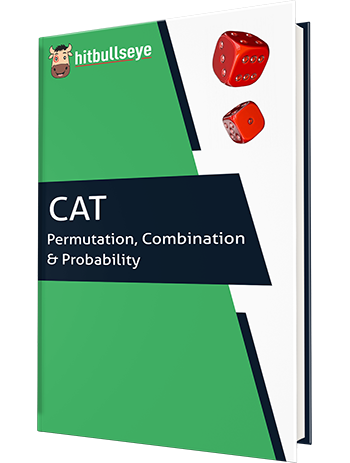
Hitbullseye e-book on Permutation and Combination
Hitbullseye’s Quant team has compiled an e-book of 100 moderate and advanced P&C and Probability questions for this section. It is designed for the application step, after the counting principle is in place.
The e-book contains:
- Fundamental principles of counting
- Permutations, with solved examples
- Definition of probability
- Bayes’ rule and miscellaneous solved examples
Each question is solved, so the check includes the method and the answer. Use the first pass to fix the method. Use a second pass, timed, for speed. The set will soon be available for download.
Download Now
CAT Permutation & Combination Preparation FAQs
Q. How many P&C questions come in CAT?
A. Based on the recent CAT analysis, P&C and Probability account for 0–1 question per slot. It is not fixed. Some slots have none.
Q. Is P&C worth preparing for CAT 2026?
A. Yes, prepare for it at the basic level. One correct question is 3 marks. Do not dedicate a similar amount of time or hours to it as you do for the high-weightage topics like Arithmetic and Algebra.
Q. What is the difference between permutation and combination?
A. The difference lies in the Order. If swapping two selected items changes the result, count a permutation. If it does not, count a combination.
Q. What should I leave if time is short?
A. In case you are running short of time for preparation, you may leave out Circular permutations and Bayes’ rule. Keep the product rule, selection versus arrangement, and identical-object arrangements.


 E-305, Industrial Area, Sahibzada Ajit Singh Nagar, Punjab 160055, IN