After students successfully attempt their management entrance exams, such as CAT, XAT, NMAT, and SNAP, they then shift their attention to the Group Discussion and Personal Interview (GDPI) preparation phase. This stage, frequently overlooked during the initial preparation phase, carries equal, if not greater, significance in the overall admissions process.
Before we go ahead and discuss how to prepare better for these rounds, let’s first try to understand: what is the rationale for B-schools conducting interview rounds when they can select candidates purely on competitive exam scores, as is common in engineering and medical exams such as JEE, NEET UG, and CUET?
The answer lies in understanding the structural differences between an MBA/PGP program and a B.Tech/B.Com program. MBAs and PGPs are postgraduate programs that require much higher maturity, exposure, and experience than undergraduate programs. Hence, to evaluate these aspects, judging students solely on their performance in a standardized test does not highlight their full capabilities to succeed in a management program.
B-schools and management programs are designed to develop well-rounded professionals who not only possess great analytical skills but can also drive business growth. Thus, interacting with candidates in Personal Interview rounds helps check for a structured thought process, effective communication, and their ability to handle pressure, which are important ingredients for becoming a well-rounded professional.
As a result, interview processes such as Personal Interviews and Group Discussions have become standard practice in management admissions in India, serving as essential tools for evaluating prospective students.
How Have B-School Admissions Transformed?
B-schools in India typically use two main interview formats to evaluate candidates:
- Personal Interview Round: This is to judge whether a candidate has a consistent thought process, communicates well, and has reasonable depth in avenues related to their academic, professional, and co-/extra-curricular backgrounds.
- Group Discussion: Evaluates the ability of a student to work in teams, coordinate with others, present ideas, and contributes to group progress.
As industry demands shift toward specialized skills and expertise, expectations for B-school graduates have evolved as well.
The MBA program, which originated at Harvard University in 1908, was designed as a generalist program to address the growing demands of the emerging post-industrial economy. Suddenly, there was a demand for a middle layer of 'managers' positioned between senior leadership and operational staff, who could convert strategic business objectives into measurable outcomes.
Initially, managers were trained across all business disciplines, including finance, operations, human resources, sales, marketing, and, later, information technology. Today, however, the industry requires both broad cross-functional knowledge and specialized expertise in specific domains. As a result, horizontal awareness is now considered a baseline expectation in students, while vertical depth in specific areas helps distinguish candidates.
In response to these evolving expectations, B-schools have now modified their evaluation processes. Today, methods such as the Written Ability Test (WAT), Case Interviews, and Group Interview rounds enable institutions to gain deeper insights into each candidate’s skills and motivations.
At present, only a few select groups of progressive institutes utilize these contemporary interview formats in India. While this approach is more common among global business schools in the United States, Indian institutions such as SPJIMR, Symbiosis, Altera Institute, etc., have also implemented it.
What is the Case Interview Format at Altera Institute?
The Case Interview Round at Altera Institute consists of a 30 to 40-minute session during which candidates receive a brief case study, which is typically one or two pages in length, and are allotted 10 minutes to review it. They are then required to develop solutions to a given objective and to discuss their recommendations interactively with the interviewer, who may also ask follow-up questions on various aspects of the case.
The aspects on which students are judged in the case interview round are:
- Their ability to think in a structured manner in an uncertain situation.
- The effectiveness with which candidates communicate their viewpoints within the appropriate context.
- And, finally, the ability to lead the problem-solving process logically, rather than relying on hit-and-trial approaches.
Some common pitfalls in case interview rounds include:
- Approaching the session as a formal Viva rather than a discussion.
- Overemphasizing the final solution rather than the problem-solving approach.
- Failing to articulate the different reasoning properly
- And finally, not engaging enough with the interview panel.
Why does Altera Institute prioritize the Case Interview Round?
Altera Institute is an industry-backed B-school with a hands-on approach that prepares students for careers in Digital and AI-focused fields such as Growth, Product Management, eCommerce, Founders' Office/EIR, Brand Management, etc.
Therefore, all the elements assessed in this case interview round are not supplementary but an absolute essential for evaluating candidates. The case interview round thoroughly tests a candidate’s ability to think from first principles, understand business problems, identify pragmatic solutions, and think from an execution-first lens. These are important, if not necessary, traits to look for in candidates selected for such a rigorous program with a Digital & AI-first curriculum.
Representative Case Studies Examples from Altera Institute
Below are two examples of problem statements given to students last year during the case interview round at Altera Institute:
1.BookMyShow Monetization Strategy:
Candidates acted as strategists for BookMyShow, India's largest entertainment ticketing platform. The challenge was to improve monetization through premium subscription plans amid the slow growth in Tier-1 cities and new competition from Zomato's District app. Students had to analyze segment-wise data (Urban Millennials vs. Tier-2 Families vs. Event Enthusiasts) to determine benefits, pricing, and marketing strategies for a new subscription service and address high churn rates caused by convenience fees.
2.Coca-Cola vs. "Thirsty" Brand Challenge:
Candidates assumed the role of Marketing Manager for Coca-Cola to address the rise of "Thirsty," a budget brand that gained 15% rural market share in six months by pricing products 25-30% lower. With Coca-Cola's rural share dropping from 30% to 21%, students had to analyze market data to recommend investment focus, pricing strategies, and new approaches to counter the competitor without diluting Coca-Cola's premium positioning.
These examples represent typical cases discussed during the case study round at the Altera Institute. Notably, even candidates without prior industry knowledge can still develop viable solutions for these case studies by focusing on fundamental principles and employing logical problem-solving approaches.
The USPs of Altera Institute's PGP Course
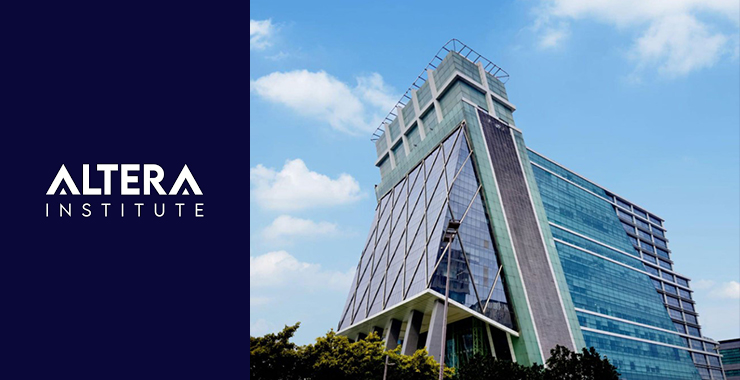
Altera Institute, an industry-backed B-school located in Gurugram’s Cybercity, prepares students for careers in Digital and AI-focused fields. Unlike traditional MBA programs, Altera Institute offers a modern upgrade to business education designed to prepare students for high-growth roles in areas such as eCommerce, Brand Management, Growth, Product Management, Founders’ Office/EIR positions, etc.
Its flagship, the PGP in Applied Marketing, is a 15-month, full-time, residential program that is built on three key pillars:
- First, the curriculum is created and delivered 100% by industry leaders, including CXOs, founders, and marketing heads from companies such as Amazon, Hindustan Unilever Limited, Mondelez, GSK, Bain & Company, and Goldman Sachs. This ensures that the curriculum is aligned with current market demands and is not purely theoretical.
- Second, the teaching methodology is highly practical. Students work on live projects with real companies, attend bootcamps where they build their own product MVPs and D2C brands, complete capstone projects, and solve business problems alongside industry experts. They also receive over 300 hours of career preparation above and beyond the learning hours mentioned above as well as one-on-one mentorship.
- Third, the institute also helps students secure jobs in Digital and AI-first positions that would otherwise be inaccessible to graduates of a traditional B-school. The interviews and case study rounds at the institute are all designed in such a manner that only candidates who are most likely to succeed in this dynamic and innovative environment are selected.
Placement Outcomes and Cohort Composition
The PGP admissions process at Altera Institute is highly competitive due to the fact that the institution has been able to build a reputation for itself by demonstrating strong placement outcomes for its last two cohorts. The Class of 2025 placement report has also been released recently by the institute and is likely to drive up the volume of applications this year, leading to more competitive cutoffs for the following year of admissions.
The 2025 placement results by Altera Institute position it as a strong contender for students seeking options beyond the top 10-15 B-schools in India.
Regarding the class of ‘25, they achieved a 100% placement rate. The median salary was ₹18.14 LPA, the average was ₹16.85 LPA, and the highest offer was ₹26.08 LPA. It is interesting to note that 70% of students were placed in roles that exceeded ₹15 LPA, and these were high-growth roles, usually offered in Tier-1 B-Schools.
The role distribution reflects specialization:
- 35% of the students found positions in eCommerce.
- 24% moved into Founder's Office and EIR roles.
- 12% secured Revenue and Growth positions.
- 9% entered Product Management functions.
- 9% entered Brand Management.
- And, finally, 11% of students secured FMCG Sales & Marketing roles.
Top recruiters at Altera Institute include Amazon, Flipkart, Godrej, Honasa Consumer, Himalaya, Mamaearth, Supertails, and several D2C and consumer tech companies.
It is important to note that Altera Institute's placement report follows IPRS (Indian Placement Reporting Standards) Revision 2.2, the same standard developed and used by IIM Ahmedabad. This enables Altera Institute to provide a detailed description of Fixed Yearly Cash, One-Time Cash Payments, Variable Pay, and performance-based Components; and across various cuts like Freshers vs Experienced, Location-wise split, etc., the information is usually not provided transparently in most B-schools.
The current PGP class of 2026 has 135 students, out of which 65% of them have at least 24 months of prior work experience. Many have left companies such as Nestle, Titan, Deloitte, PepsiCo, Marico, Goldman Sachs, Asian Paints, KPMG, CGI, Citibank, NielsenIQ, and Reliance to pursue structured learning at Altera Institute.
The remaining 35% are freshers who bring strong internship experience and academic backgrounds from institutes such as Hindu College, Christ Bangalore, NMIMS, KJ Somaiya, and Mumbai University.
Conclusion
This shift in the method of interviewing B-school candidates with the help of a case study round is an indication reflecting a more fundamental change in the business environment, where a conceptual knowledge of business is no longer sufficient as a precursor to career achievement.
Therefore, Altera Institute ensures that its cohort not only has the necessary academic skills but is also industry-ready by rigorously assessing their ability to solve problems, their data analysis capabilities, and their strategic communication skills in unstructured situations.
For applicants, winning this process does not depend on always giving the right answers but rather on showcasing an organized thought process and flexibility, which will render them successful in today’s Digital and AI-driven economy.
 E-305, Industrial Area, Sahibzada Ajit Singh Nagar, Punjab 160055, IN