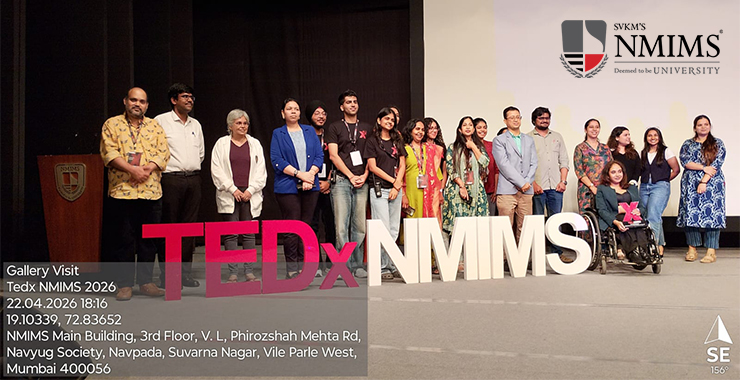
The auditorium at NMIMS (deemed-to-be) University Mumbai campus fell into a quiet reverence on Wednesday afternoon, 22 April 2026, as the Saraswati Vandana opened what would prove to be one of the most thought-provoking events the campus has seen this year. After students rose for the NMIMS anthem, the stage was set with a single provocation — the event's theme, Sui Generis, Latin for 'one of a kind.' In an age where artificial intelligence can write, design, and generate almost anything, the questions asked: what is irreducibly, distinctly human?
Dr Arjun Ghosh, faculty at IIT Delhi Abu Dhabi campus and a researcher working at the intersection of language, technology, and historical archives, opened the speaker sessions by tracing a long arc — from pre-modern manuscripts that flowed freely between scripts and languages, through the rigid standardisation of print, to the digital present where those same hierarchies are being quietly reproduced in code. Dr Ghosh warned that the tools being built today still serve only a fraction of the world's languages. "The question is no longer whether machines can understand language," he said, "The question is: whose language will they choose to understand?"
Mr. Ayush Bagga, entrepreneur and sustainability founder, followed with a provocation of his own: if answers are now free and instant, what exactly is a person worth? His answer was disarmingly simple — the quality of one's questions. Drawing on the legacies of Einstein and Nikola Tesla, the work of Mr. Nandan Nilekani, and NMIMS alumna Ms. Richa Kar, founder of Zivame, Mr. Bagga argued that every great innovation traces back not to a new technology but to a question no one had dared ask. "In a world where every answer is one prompt away, the person who wins is not the one with the best answers — it is the one who asks questions no one else thought to ask."
Ms. Namrata Chawla, writer and entrepreneur, brought the debate closer to home. Ms. Chawla spoke candidly about the fear she felt when AI arrived two months into her first job — but insisted the framing was wrong. "AI has no taste. It has no lived experience. You are the tastemaker." Her closing assertion — that someone who knows how to use AI will replace someone who does not — resonated strongly with the audience.
Dr. Rashi Agarwal, psychiatrist and mental health expert, offered a more unsettling perspective. “Are our thoughts even original anymore?” asked by Dr. Agarwal, “When we outsource our emails, queries, and creative work to AI by reflex”? Citing neurological research showing weakened attention and memory networks among those who rely on predictive tools, Dr. Agarwal introduced the concept of 'cognitive debt.' Her challenge to the room was pointed: demand technology that challenges you, not one that simply agrees with you.
The afternoon's most moving address came from Ms. Maahi Rudawat, a 21-year-old wheelchair user born with Spina Bifida. While the world debates whether to fear artificial intelligence, Ms. Rudawat said, people like her have been waiting for it — AI-powered wheelchairs, smart prosthetics, and health applications that restore control over one's own body. "For many, this is innovation," she said. "For us, this is independence."
Mr. Joel James, co-founder of Studio Blo, and also an alumni closed the session with a direct and energising address. Mr. James urged students to lean into their unfair advantages — the specific combination of background, experience, and perspective that no algorithm can replicate — and to reframe their relationship with failure. Spending six months perfecting something that will not work, he argued, is far costlier than moving decisively, learning early, and pivoting. "Play where only you can win."
By the time the event drew to a close, the theme of Sui Generis had held. The room had spent the afternoon not debating artificial intelligence, but rediscovering what it cannot touch: lived experience, personal courage, and the willingness to ask the question no one else will. Ms Niharika Dusi, the third year student of BA Liberal Arts of Jyoti Dalal School of Liberal Arts, who got the licence to organize TEDx NMIMS 2026 said, “The event has not only brought great minds on the stage but also opened a space for dialogue around AI, creativity and the potential of human mind”.
All the speakers were felicitated by the Officiating Vice Chancellor, Dr Meena Chintamaneni and the Registrar, Dr Tanmoy Chakraborty of NMIMS (deemed-to-be) University. Dr Chintamaneni thanked the organizing team and the speakers, and encouraged all to organize the next TEDx NMIMS bigger reaching to other colleges of Mumbai too!
NMIMS, Mumbai
About TEDx, x = independently organized event
In the spirit of discovering and spreading ideas, TEDx is a program of local, self-organized events that bring people together to share a TED-like experience. At a TEDx event, TED Talks video and live speakers combine to spark deep discussion and connection. These local, self-organized events are branded TEDx, where x = independently organized TED event. The TED Conference provides general guidance for the TEDx program, but individual TEDx events are self-organized. (Subject to certain rules and regulations.)
About TED
TED is a nonprofit, nonpartisan organization dedicated to discovering, debating and spreading ideas that spark conversation, deepen understanding and drive meaningful change. Our organization is devoted to curiosity, reason, wonder and the pursuit of knowledge — without an agenda. We welcome people from every discipline and culture who seek a deeper understanding of the world and connection with others, and we invite everyone to engage with ideas and activate them in your community.
TED began in 1984 as a conference where Technology, Entertainment and Design converged, but today it spans a multitude of worldwide communities and initiatives exploring everything from science and business to education, arts and global issues. In addition to the TED Talks curated from our annual conferences and published on TED.com, we produce original podcasts, short video series, animated educational lessons (TED-Ed) and TV programs that are translated into more than 100 languages and distributed via partnerships around the world. Each year, thousands of independently run TEDx events. Through the Audacious Project, TED has helped catalyze $6.6 billion in funding for projects that support bold solutions to the world's most urgent challenges — working to make the world more beautiful, sustainable and just. In 2020, TED launched Countdown, an initiative to accelerate solutions to the climate crisis and mobilize a movement for a net-zero future, and in 2023 TED launched TED Democracy to spark a new kind of conversation focused on realistic pathways towards a more vibrant and equitable future. View a full list of TED’s many programs and initiatives.
Follow TED on Facebook, Instagram, LinkedIn, TikTok, and X.
 E-305, Industrial Area, Sahibzada Ajit Singh Nagar, Punjab 160055, IN